
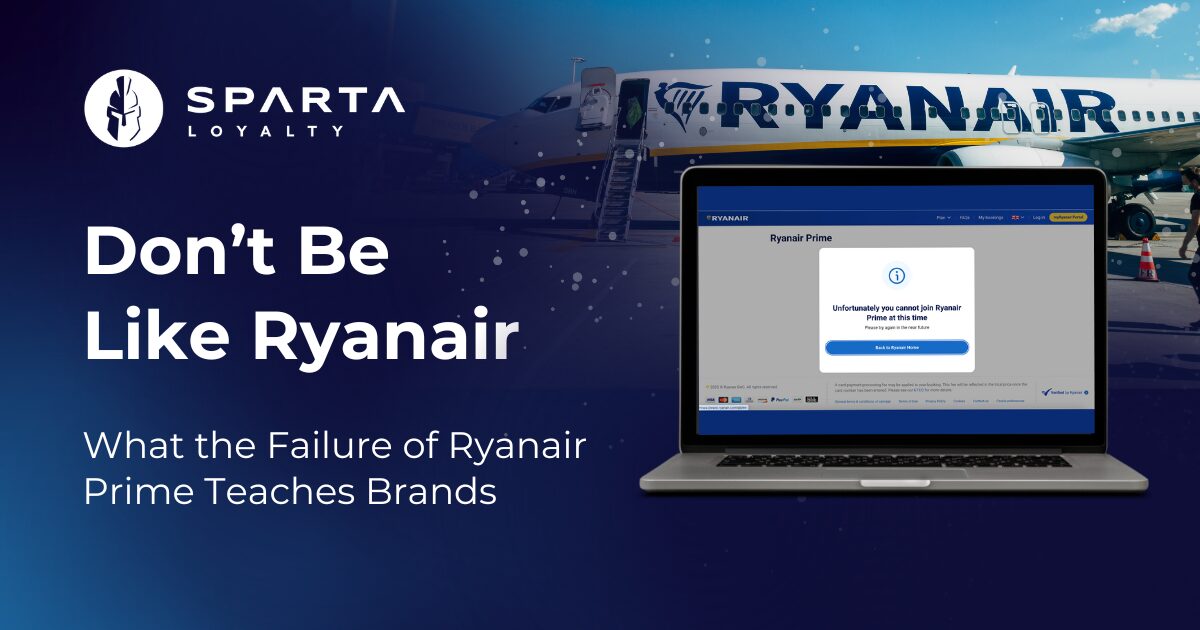
Can customers be too loyal? According to Ryanair — yes. The collapse of its Ryanair Prime program, which disappeared just eight months after launch, offers a bitter lesson for the entire industry. The airline openly admitted that the “generosity” of its subscription cost too much — and customers… used the free perks too often. How is it possible that a loyalty program was killed by its own popularity? The answer lies in a strategic mistake that could easily have been avoided.
Loyalty self-destruction in the name of false savings
Ryanair’s story reads almost paradoxically. The airline known for maximizing profits through add-on fees created a program that eliminated those very charges. If the problem was “too much popularity” and the cost of benefits, was the program really to blame?
Here lies Ryanair’s fundamental strategic flaw. A loyalty program should never be a goal in itself — it’s a strategic tool for generating profit from relationships. If a company claims its customers have become too loyal, it means only one thing: the program was badly designed from the ground up, and its goals conflicted with the core business model.
“A loyalty program in a low-cost sector must be a precise instrument that aligns with the brand’s strategy and customer expectations. That wasn’t the case with Ryanair Prime. Instead of motivating customers to spend more in other areas, the program simply took away valuable margin from Ryanair’s core services. That’s not loyalty — that’s subsidizing the customer. And subsidies can never be a sustainable business strategy,” says Filip Zajdel, Head of Customer Success at Sparta Loyalty.
A well-designed program should *increase* the profitability of loyal customers — not reduce it. Overly generous, non-personalized benefits in a low-cost environment, where the base price is already minimal, quickly eat into margins. Ryanair Prime didn’t encourage more profitable behaviors; it only rewarded the basic, least valuable ones.
In truth, Ryanair didn’t lose money because of customer loyalty — it lost because the program’s mechanics were misaligned with its revenue model.
The subscription model: understanding revenue streams
Ryanair Prime wasn’t a standard point-based loyalty program but a subscription model designed to generate a steady, predictable income stream of €79 (or £79) annually.
Subscription programs like Amazon Prime or those adopted in travel operate on two pillars:
1. Subscription fee – a fixed, recurring revenue source independent of transactions.
2. Behavioral change – the heart of the model. Subscriptions are meant to immerse the customer in the brand’s ecosystem, increasing purchase frequency and spend on higher-margin products (as in Amazon Prime, where users buy more because shipping feels “free”).
What went wrong with Ryanair Prime?
The program acted as a *shield* protecting customers from Ryanair’s fees — not as a *lever* to drive additional sales. It gave customers ways to avoid paying for standard services rather than motivating them to purchase extras like Fast Track access, premium fares, or hotel packages. Instead of generating new profit streams, it cannibalized existing ones.
Loyalty is an investment, not a cost
To avoid Ryanair’s trap, brands must revisit what loyalty truly means. It’s not about giving customers freebies — it’s about teaching them behaviors that create *mutual value*.
“A loyalty program is a mechanism for monetizing relationships. Its top goals should be to increase purchase frequency and the average transaction value. If a customer flies twice as often thanks to the program but generates zero profit because of free perks, that’s a strategic failure. Benefits should be tied directly to growth — for example, free seat selection only after booking a higher-tier travel bundle,” explains Zajdel.
A well-executed loyalty program should achieve three things:
1. Generate compensatory revenue.
Benefits must correlate with behaviors that boost revenue or reduce operational costs, such as encouraging mobile check-in to cut airport service costs.
2. Build retention and data value.
Keeping customers within the brand ecosystem and collecting behavioral data allows for hyper-personalized offers — which in turn increase margin per customer.
3. Increase Lifetime Value (LTV).
A loyal customer should become *more* profitable over time.
The formula for success: how to design a program you won’t regret
Ryanair’s example shows that even an industry leader can stumble on the basics. To avoid that pitfall, programs must be designed strategically around profitability data.
1. Reward valuable behaviors, not just status.
Loyalty shouldn’t come from paying a yearly fee. Reward actions that build brand value — like app referrals, off-season bookings (filling empty seats), or cross-service engagement. Rewards should be challenging to earn but highly desirable.
2. Leverage status and exclusivity instead of discounts.
People value status. Instead of offering free seat reservations, offer early access to new routes, priority notifications for discounts, or dedicated customer support. Such perks hold high emotional value but low financial cost.
3. Focus on segmentation and personalization.
One-size-fits-all never works — as Ryanair Prime proved. With a loyalty platform, segmentation can unlock real effectiveness:
– Business travelers value flexibility and priority (time and status are their rewards).
– Family travelers value guaranteed seating together and reduced baggage fees (safety and savings).
Personalization ensures the benefit resonates — maximizing motivation while minimizing cost.
“By shutting down its loyalty program, Ryanair sent a signal: our profit matters more than our relationship. Loyalty is a long-term investment. The failure of Ryanair Prime isn’t a failure of loyalty as a concept — it’s a failure of poor, unbalanced strategy. True loyalty is win-win — never a cost to be cut at the first sign of trouble,” concludes the Sparta Loyalty expert.