
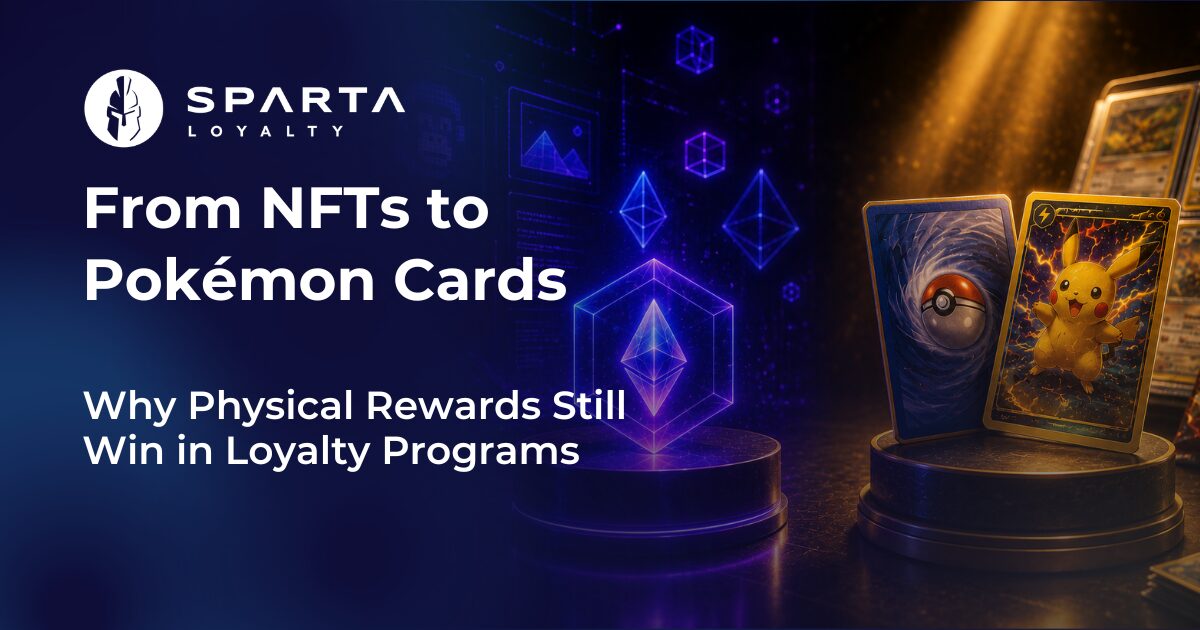
In February this year, celebrity Logan Paul purchased a rare Pikachu Illustrator card for a record-breaking price of around $16.5 million. This sends an important signal to marketing directors and loyalty program designers. In a world dominated by digitization, the metaverse, and NFT tokens, what consumers still value most are tangible items. Why do traditional, physical rewards and authentic experiences outperform their digital counterparts?
A Pokémon card is still just ink on cardboard. Yet its enormous value comes from its uniqueness, nostalgia, and the status it holds within a community. Unlike digital loyalty experiments based on NFTs, which quickly lost market interest, physical collectibles have maintained their position and value for decades.
The anatomy of physical loyalty
Physical objects have advantages that are difficult to fully replicate in the digital world:
- Uniqueness. The number of limited-edition physical items is fixed. If one is destroyed, the loss is irreversible. This uniqueness is anchored in the real world, not in a database.
- History and narrative. A tangible item carries its own story—its origin or association with specific individuals.
- Community validation. Value is built within ecosystems based on shared standards and rituals. It is the community—not a speculative “roadmap”—that determines what matters.
“Effective loyalty programs work in exactly the same way. The most meaningful benefits are not abstract points, but experiences, access to something unique, and symbolic rewards that signal a customer’s status within a community,” comments Alexander Kubicki, Head of Marketing and Global Sales at Sparta Loyalty. “Many digital strategy creators have forgotten that technology should be an invisible engine, not a goal in itself.”
Local game stores: living loyalty labs
A perfect example of building authentic loyalty can be found in local board game and trading card shops (LGS – Local Game Stores). These are not just retail outlets, but community hubs where people regularly gather for tournaments, game nights, or miniature painting workshops.
What can loyalty managers learn from this?
- Experiences first. Players return because their friends and emotions are there—not because a product is 10% cheaper.
- Emotional rewards as currency. A trophy for winning a league or a unique promo card carries more value than a generic discount coupon.
- The power of habit and rhythm. Regular events turn attendance into habit—and habit is the strongest form of loyalty.
The loyalty ecosystem: role of distributors and technology
In the hobby world, publishers such as Wizards of the Coast or Games Workshop act as providers of a loyalty platform for the entire market. They create organized play systems, supply limited products, and host global championships, while local stores implement these frameworks at the community level.
This model closely mirrors modern retail and franchise structures.
“Modern loyalty in retail or services must operate on two levels,” notes Alexander Kubicki from Sparta Loyalty. “The company selects, implements, and delivers a powerful technology engine, data analytics, mechanics, and a global reward catalog. However, it is local partners—stores, gas stations, franchisees, or pharmacies—that bring the program to life by creating customer experiences and engagement. Our years of experience implementing systems for large networks show that when these two layers work together, a program stops being just a points calculator and becomes an ecosystem of real engagement.”
The psychology of tangibility
Why do programs based solely on digital rewards often fail? They lack identity and do not provide real emotional impact. A Discord server cannot replace multisensory experiences. Physical rewards directly address human needs:
- Sensory memory. Touch, weight, and texture help encode memories. A metal card or physical trophy leaves a deeper mark than a digital badge in an app.
- Visible status. An item placed on a desk or a branded hoodie worn daily naturally prompts the question, “Where did you get that?”—the beginning of a brand story.
- Social circulation. Physical items can be traded, gifted, or passed on. Points disappear when spent; objects build stories.
What this means for marketers: four steps to modern loyalty
The conclusion is clear. Brands and loyalty technology providers should put people—their experiences and emotions—at the center of all activities. Technology cannot replace this; it can only coordinate and support loyalty initiatives and communication.
Four pillars of a modern loyalty strategy:
- Design experiences (earn-and-experience instead of earn-and-burn).
- Create trophy rewards (unique, limited items with a story).
- Connect digital with physical (the app guides, the customer touches the reward).
- Build micro-communities around local points of sale.
A free coffee in a loyalty program is standard; a limited-edition mug that only the most loyal customers can earn—that is a story.
Loyalty program managers can draw an important lesson from the collectibles market. The future belongs to ecosystems where technology supports—not replaces—real human experiences and tangible rewards, because a single unique card is worth more than thousands of digital badges.