
Nearly 600 million registered users, 270 million active buyers over the course of a year, and as many as 100 million paying subscribers. The results of KFC’s loyalty program in China seem almost abstract. It is easy to put it down to the country’s enormous population, but the truth is quite different. Asia won the battle for the customer not through demographics, but through pricing architecture, program convenience and paid subscription tiers. What can — and should — loyalty managers take away from this lesson?
Loyalty isn’t points; it’s a business model
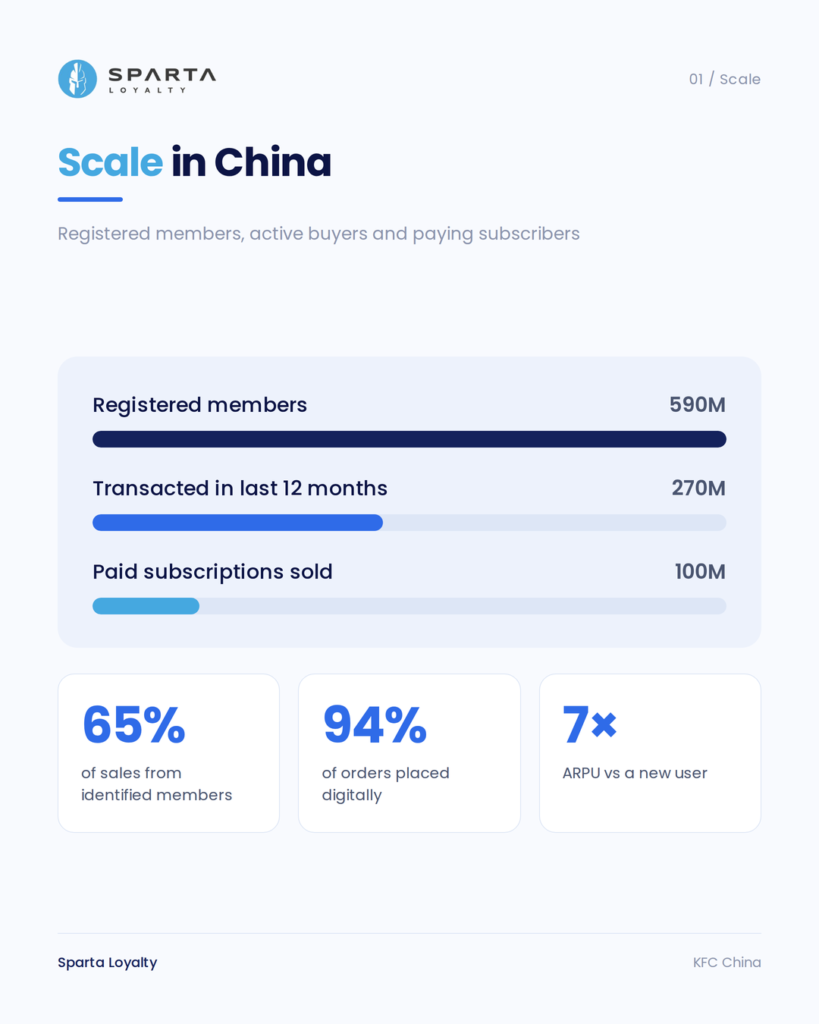
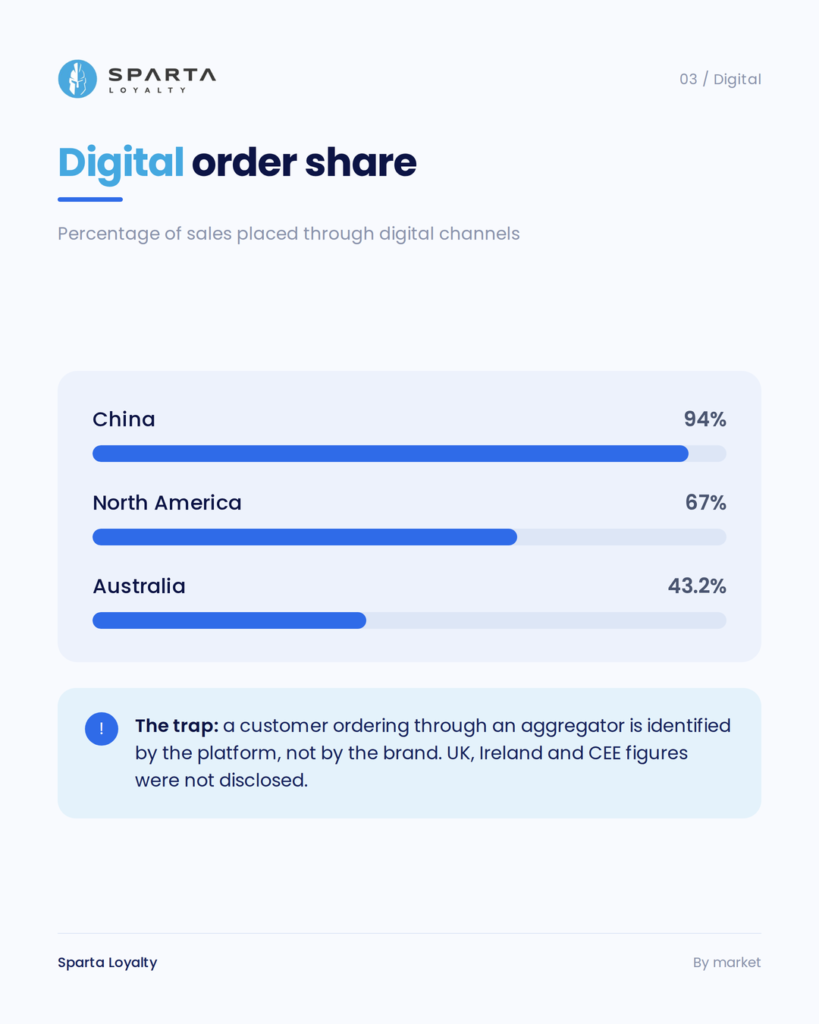
When Yum China presented its financial results, Western analysts summed them up briefly: “This is madness.” But the scale (more than 40% of China’s population enrolled in the KFC and Pizza Hut program) is only the tip of the iceberg. The key figure is the number of users who made a transaction in the past 12 months — 270 million. As much as 65% of total sales at KFC’s outlets in China is generated by identified program members, and digital orders there reach 94%.
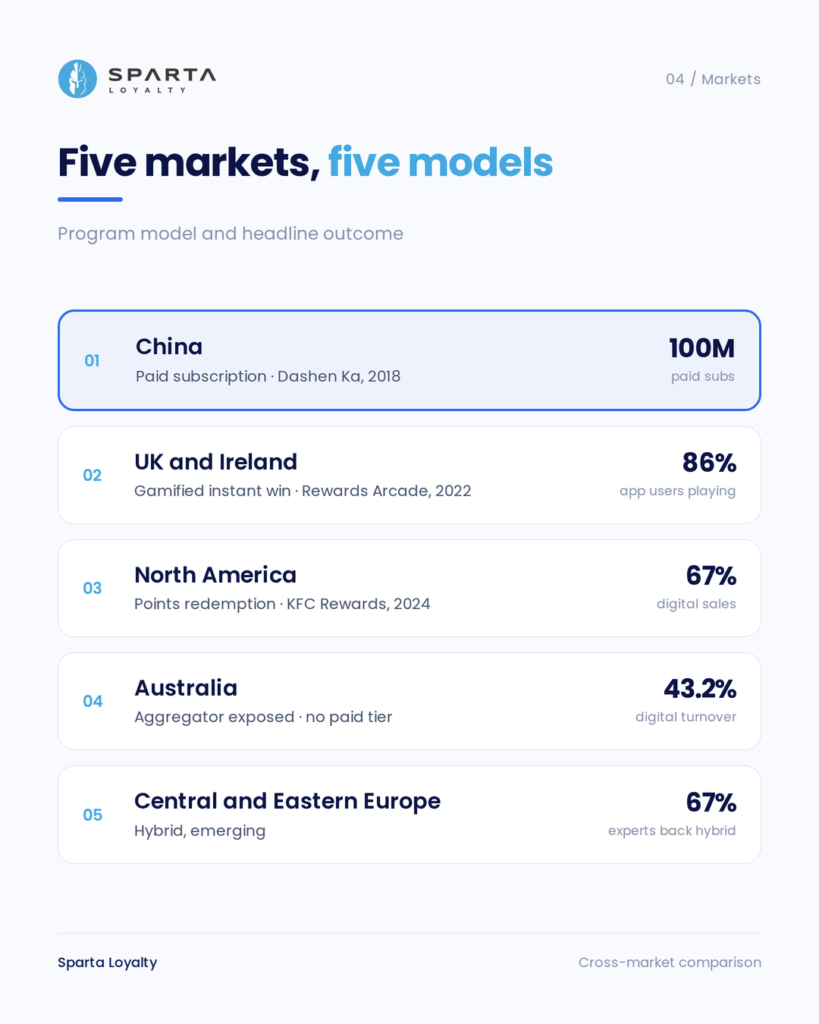
How was this achieved? Unlike Western markets, where loyalty programs still often rely on the slow collection of stamps, in 2018 KFC China bet on a paid subscription (“Dashen Ka”). The user pays a fixed fee and in return receives immediate benefits: free delivery above a certain order value, cheaper meal deals, and priority service.
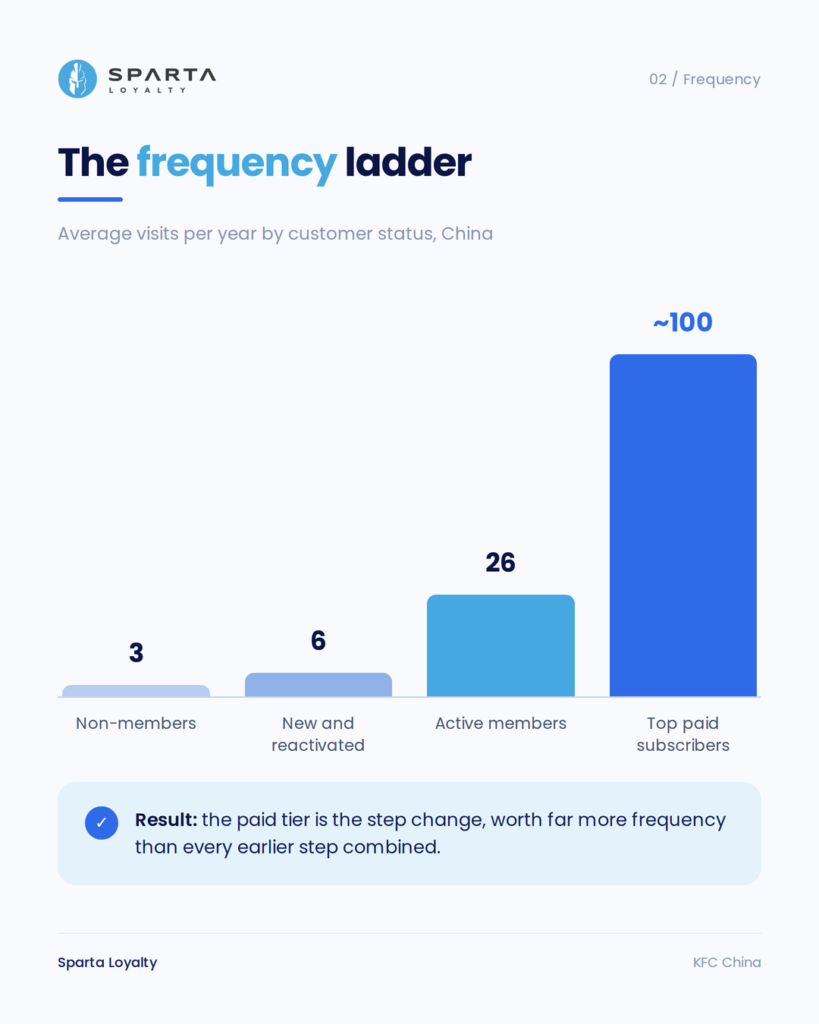
The result? Average revenue per user (ARPU) from a paying member is more than seven times higher than from a new user, while annual visit frequency rises from 3 (for non-members) to as many as 26 (for members) — and 100 visits a year for the most engaged million subscribers.
How does the Western market compare? In the long-since-withdrawn British Colonel’s Club, fewer than one in four KFC customers joined the program. The results were poor — loyalty transactions generated barely 4% of the chain’s revenue, while running and maintaining the program cost the company as much as £3.4 million.
From 3 to 100 visits a year. The power of immediate benefits
The mechanic that is decisive in KFC China’s case is not points. It is the paid subscription. KFC China launched the “Dashen Ka” subscription, sold on a renewable basis, at the end of 2018. It offered free delivery above a certain order value, discounted breakfast and afternoon meal deals, and priority in the delivery queue. UBS estimated at the time that the solution doubled monthly spending at KFC. By the end of 2022, the company had sold a total of over 100 million such subscriptions.
The program distinguishes four customer statuses: customers who are not members, new and reactivated users, existing users, and paying subscribers. Annual visit frequency in these groups is 3, 6, and 26, respectively, and for the top group of subscribers it reaches roughly 100 visits a year. What is more, the ARPU of a paying member is more than seven times higher than that of a new customer.
A global review of loyalty. From gamification to the intermediary trap
So how does KFC handle loyalty in other markets?
The United Kingdom and Ireland took the most creative approach. In 2022 the chain replaced traditional stamps with the Rewards Arcade module, built on gamification with instant wins. Although engagement proved impressive (86% of app users took part in the game), the solution was merely an attractive overlay on a base of identified customers that was still too small.
North America launched the KFC Rewards program in 2024. It is based on redeeming points in a rotating “Secret Recipe Vault” and on a strong emphasis on digital orders, which in the second quarter of 2026 already accounted for 67% of sales.
Australia generates 43.2% of its turnover through digital channels, although a significant share of those transactions comes in via third-party sales platforms.
And this is precisely where the biggest trap lies: a customer ordering through an external intermediary is identified by that intermediary’s platform, not by the brand. Traffic flowing through a partner channel to which the brand has no exclusive rights does not build the brand’s own loyalty base.
- Transactions flowing through channels you do not own generate short-term turnover, but in the long run they destroy your loyalty ecosystem. In Poland and the CEE region we see mature consumers who are very willing to use brands’ mobile apps. Focusing on your own channel and using AI to personalise offers in real time is the only way to bring down rising customer acquisition costs — explains Alexander Kubicki, Head of Marketing at Sparta Loyalty.
China — not an exception to the rule, but a new trend
The outstanding results in Asia are not an isolated incident — they are part of a global shift in how marketing is understood. The Polish and European loyalty industry is going through exactly the same evolution today.
A move away from traditional points towards hybrid models. In China, growth is driven by subscription. In new Sparta Loyalty research, as many as 67% of experts named the hybrid model (free tiers + paid/premium tiers) as the most future-proof. Only 25% of respondents pointed to the traditional points model.
An end to complexity — the focus is on convenience. As many as 47% of users abandon loyalty programs because they are too complicated, and 27% give up when they have to wait too long for rewards. This is exactly why 63% of brands in the Sparta Loyalty study declare that in 2027 they will focus on loyalty built on convenience and low effort.
Business looks at profit — CLV is what counts. The market expects hard data. As many as 50% of leaders regard Customer Lifetime Value (CLV) as the main measure of a program’s success.
- The results of this year’s research leave no room for illusion: the era of slowly collecting points is over. The KFC case from China perfectly illustrates what we are also seeing in the Central and Eastern European market — the winners are the brands that deliver immediate value and simplify buying. If a program is complicated, the customer will abandon it. The future belongs to transparent hybrid models in which a paid subscription or premium tier rapidly increases customer lifetime value (CLV) — says Tomasz Wawrzynów, CEO of Sparta Loyalty.
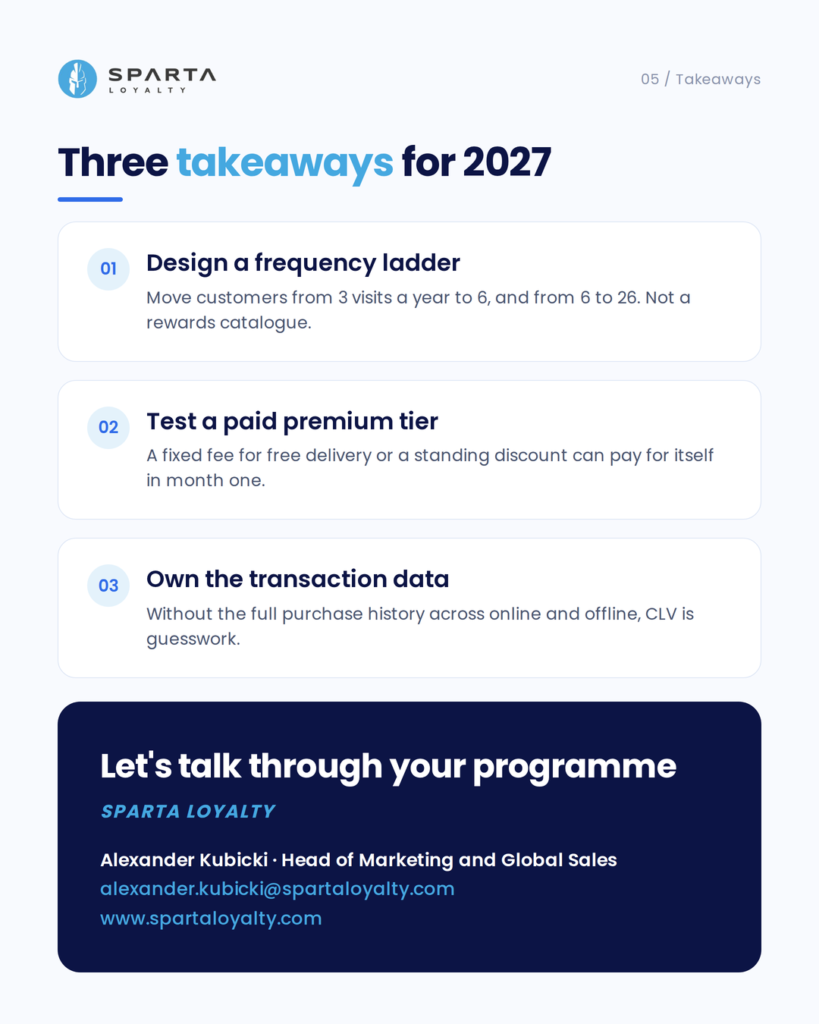
Three takeaways to apply to your own loyalty program in 2027
- Design a purchase frequency ladder, not just rewards.
Instead of wondering which gadget to put in the rewards catalogue, analyse how often your customers visit. Build your benefits policy so that it moves users from 3 visits a year to 6, and from 6 to 26. - Consider introducing a premium (paid) tier.
Paid membership (for example, a fixed subscription giving free delivery or a permanent 10% off everything) requires the customer to make a psychological commitment and to use your brand. Given the average basket size in Poland, a well-designed paid tier can be attractive and profitable for the customer from the very first month. - Own your transactional data.
Invest in your own app and in consistent data across all channels (omnichannel). Only by having full knowledge of a customer’s purchase history both online and offline can you build high CLV.
- Sparta Loyalty works with KFC in Central and Eastern Europe, which is why we also watch closely what KFC is doing in China, the Americas, and Western Europe. The CEE region is in an interesting place today — our consumers are remarkably open to digital innovation and mobile apps. Over the next few years, the winning loyalty programs will be those that, instead of complicated and drawn-out point collection, offer customers a concrete price, convenience, and transparent benefits — concludes Tomasz Wawrzynów.