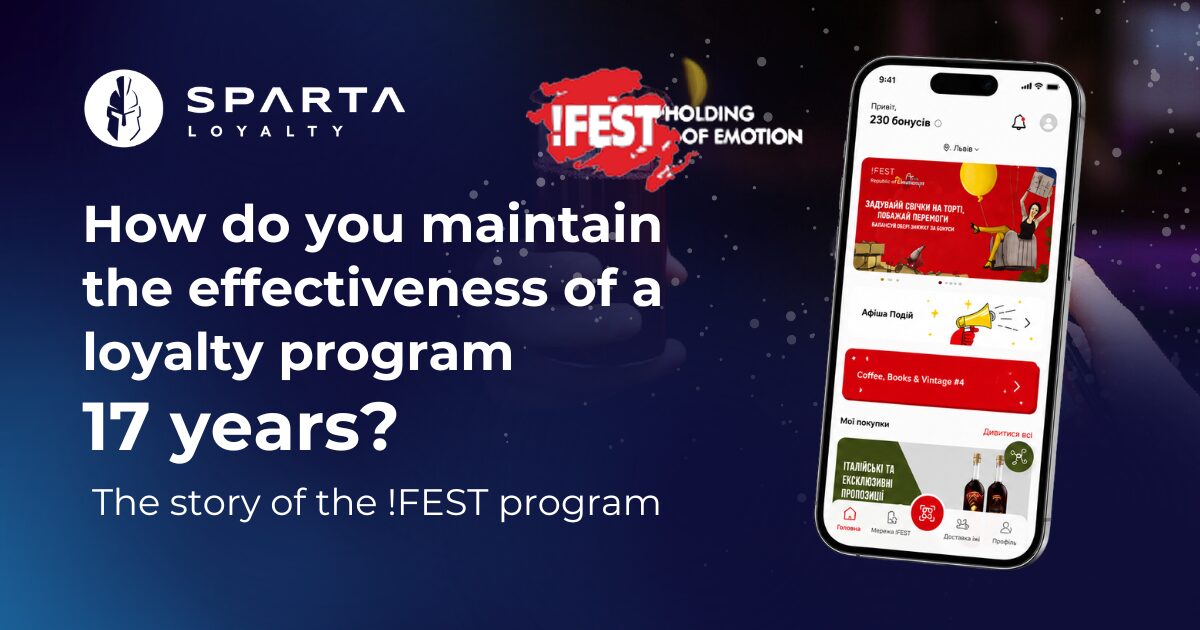
Most loyalty programs are created with rewarding purchases in mind. After a few years, however, some of them start losing their effectiveness. Consumers change, technology changes, new communication channels emerge, and customer expectations grow every year. The !FEST holding’s program shows that a completely different path is possible.
For over 17 years, the LOKAL loyalty program has been continuously evolving. Instead of remaining a collection of points and discounts, it has become a platform for building long-term customer relationships and a tool supporting the development of the entire !FEST brand ecosystem.
To fully understand this phenomenon, we first need to look at the holding’s business architecture itself. !FEST is a unique Ukrainian gastronomic and retail ecosystem, managing a network of unconventional concepts (known in Poland, among others, from the rapidly growing Pijana Wiśnia brand and the Rebernia restaurant), located in over 180 venues.
Each brand has its own identity, operational specifics, and separate target group.
LOKAL, in turn, is an advanced loyalty program shared across the entire holding, based on the Sparta Loyalty Platform. LOKAL is a cohesive coalition of brands whose internal currency—points called bonuses—serves to smoothly stimulate consumer migration within the group’s entire portfolio.
From a program for tourists to a platform building everyday relationships
The program’s story began in Lviv in 2009. At the time of its launch, the local market was largely determined by intense tourist traffic. The average customer visited the city only for a weekend, which significantly shortened the time available for using the gastronomic offer and limited the possibility of building a long-term relationship with the brand. The key business challenge for the !FEST holding thus became encouraging the consumer to visit as many diverse venues from the group’s portfolio as possible during this short stay.
The answer was implementing a solution considered, from the perspective of modern marketing, one of the fundamental pillars of effective loyalty programs—creating a shared multi-brand ecosystem. Instead of rewarding loyalty to a single venue, the program from the very beginning motivated customers to discover other restaurants, cafés, and original gastronomic concepts belonging to the !FEST holding. In this way, the organization laid the groundwork for building cross-brand loyalty, increasing its brands’ share of the customer’s wallet already at an early stage of program participation.
The magic two hours—how the psychology of instant reward increases visit frequency
In 2017, !FEST decided on a major technological and strategic change to the program. With the rise of smartphones, plastic loyalty cards began fading into history. The LOKAL program also had to move to a mobile app. However, simply digitizing the program wasn’t the goal. The real challenge was designing an experience that would encourage customers toward repeat visits from their very first contact with the app.
That’s why, in the new version of the program, developed on the Sparta Loyalty platform, !FEST implemented a simple rule: 10% cashback right after the first transaction. No need to collect points over many weeks, no complicated thresholds or conditions. The customer received the reward immediately, and that first positive experience built motivation to use the program again.
An even more interesting solution turned out to be Cross-brand Quests—tasks leading the user between brands belonging to the holding.
The scenario was simple. A customer finishes a meal at Rebernia, pays, and scans the app. A few seconds later, they receive a notification: “For the next two hours, you can get a dessert at a special price at the restaurant next door.”
This wasn’t another ad or a standard discount coupon. It was an invitation to continue the experience at another venue. The time limit built a sense of urgency while naturally directing traffic between brands within the !FEST ecosystem.
Points as a tool, not the program’s goal
From the customers’ perspective, the LOKAL program was most often associated with points and cashback. For the !FEST team, however, these were merely tools for building relationships.
From the start, the program was based on several complementary mechanics:
- Cashback from the first transaction
- A shared points balance across all brands
- The ability to use points throughout the ecosystem
- Coupons and time-limited promotions
- Reactivation campaigns
- Personalized offers
Years of program development proved that in building long-term relationships, it’s not the most elaborate loyalty mechanics that win. The best results come from solutions the customer doesn’t need to learn. If the benefit can be understood in a few seconds, the likelihood of using the program again rises significantly.
A new business reality, a new role for the loyalty program
The third decade of the 21st century completely changed the business reality—and the LOKAL program itself. 2020 brought the COVID-19 pandemic. Two years later, the outbreak of full-scale war in Ukraine dramatically changed market conditions. Lviv, for years driven by tourist traffic, lost a significant share of its visitors almost overnight. For many food-service businesses, this meant a sharp drop in revenue and the need to shut down.
The !FEST holding found itself in a similar situation, yet it had a resource that couldn’t be built overnight—a years-long base of active LOKAL program users and a direct communication channel with the local community. A new phase and role for the LOKAL program’s development began.
- 2009–2017 — Discovery. The program helped tourists discover the holding’s various venues, boosting cross-selling between brands.
- 2017–2020 — Digitization. The launch of the mobile app simplified program use and enabled faster communication with users.
- 2020–2026 — Resilience. The main goal became maintaining relationships with local residents and building a habit of regular visits.
When loyalty becomes the foundation of business resilience
The changing environment required a complete redesign of the program’s strategy. The existing mechanics, aimed at encouraging tourists to visit several venues in a single weekend, no longer fit the new reality. The priority became building regular visits among Lviv residents and maintaining long-term customer relationships.
In practice, this meant a greater focus on retention mechanics. The app began using personalized Challenges, activation campaigns, and communication tailored to user behavior. The goal was no longer just increasing the value of a single visit, but developing a lasting habit of returning to favorite venues.
It was during this period that retention stopped being merely a marketing metric. It became one of the key elements of business resilience. When the number of new customers dropped sharply, the ability to keep existing program users active proved to be one of the most important factors stabilizing the holding’s operations.
Results of the LOKAL program
The best confirmation of the program’s effectiveness is the data collected and analyzed on the Sparta Loyalty platform. It shows that a well-designed loyalty program affects not only customer satisfaction, but above all, key business metrics.
Results achieved during one of the challenges:
- Over 13,000 challenge participants
- 83% completion rate
- 50% increase in visit frequency
These results show that a loyalty program doesn’t function solely as a promotional tool. In the case of the !FEST holding, it has become one of the mechanisms supporting sales growth, increased purchase frequency, and the building of long-term customer relationships.
The loyalty program as a business product
One factor that sets LOKAL apart from many traditional loyalty programs is how it’s organized. The program doesn’t function as a periodic marketing campaign or an add-on to operations. It’s developed like a full-fledged business product.
A dedicated team with its own goals, budget, and development roadmap is responsible for its growth. Every new mechanic—from challenges and promotions to communication scenarios—is designed, tested, and optimized based on user behavior data.
This approach means the program keeps evolving alongside customer needs and market changes. As a result, loyalty stops being merely a marketing activity. Instead, it becomes one of the pillars of customer relationship management and long-term business growth.